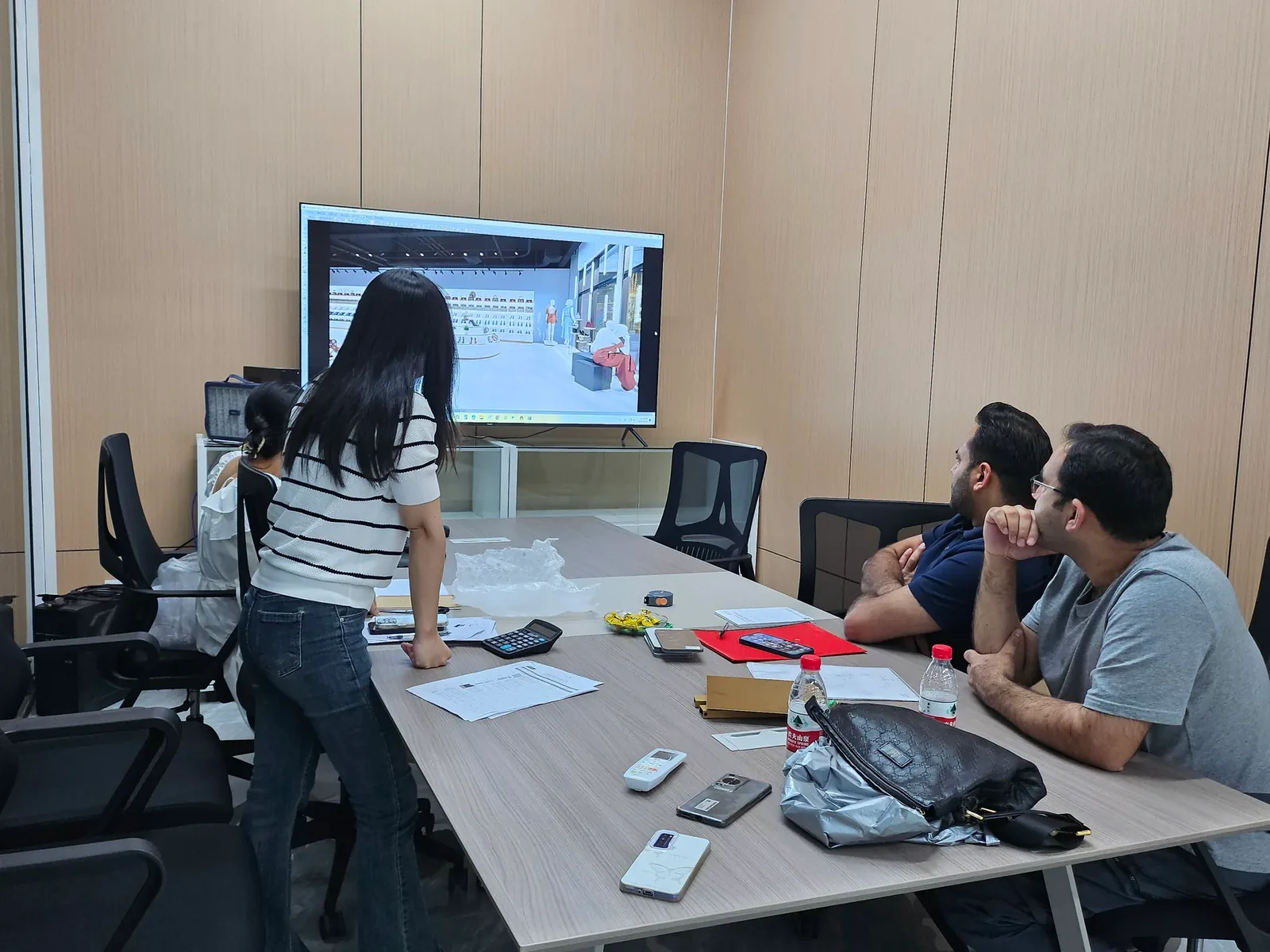
Assigning Decision Owners in a Custom Store Fixture Project
A custom store fixture project involves decisions about merchandise, appearance, dimensions, materials, price, site interfaces and delivery.
- Published
- 2026-09-08
- Updated
- 2026-09-08
- Reading time
- 8 minutes

A custom store fixture project involves decisions about merchandise, appearance, dimensions, materials, price, site interfaces and delivery. These decisions are connected, but they do not necessarily belong to the same person.
Three decisions to carry into your project.
- 01
Separate commenting from approval
- 02
Organise decisions by subject
- 03
Define the information required for a decision
Start with the decision
A custom store fixture project involves decisions about merchandise, appearance, dimensions, materials, price, site interfaces and delivery. These decisions are connected, but they do not necessarily belong to the same person. Problems arise when a supplier receives a comment from someone who cannot approve it, when two reviewers give contradictory directions, or when an important question has no recognised owner.
Create a decision-owner register before detailed review begins. It should state what needs to be decided, who prepares the information, who must be consulted, who can approve the result and who records it. The register is an operational coordination tool. It does not replace a contract or determine legal responsibility by itself; contractual obligations remain subject to the parties' actual agreement.
Separate commenting from approval
Many participants can provide useful observations. A store employee may notice an awkward retrieval operation, a brand designer may identify a colour mismatch, and a site coordinator may report an obstruction. Their comments deserve attention, but a comment is not automatically permission to change production. Distinguish the right to raise an issue from the authority to approve its resolution.
State how comments become decisions. The relevant owner should review the information, obtain any required consultation and communicate one disposition. That disposition might be accepted, rejected, revised, deferred or awaiting another input. The supplier should not be asked to choose between incompatible instructions from separate participants without knowing who has authority to resolve the conflict.
Use the distinction in meeting records and email summaries. A note that a concept was discussed should not imply that manufacturing was authorised. Likewise, agreement on appearance does not necessarily approve dimensions, construction or cost. Label the decision being made so that its scope is clear to everyone who later receives the record.

Organise decisions by subject
Start with merchandise requirements, brand appearance, spatial arrangement, engineering details, commercial scope and site coordination. Add categories where the project genuinely needs them. Avoid building an elaborate organisational chart that the team will not use. The register should help someone with a question find the person able to answer it.
For each subject, identify a primary decision owner. Other people may contribute evidence or require consultation, but there should be a clear route to one recorded answer. Where approval genuinely requires several parties, state that sequence explicitly. Do not leave the supplier to infer that approval from one participant means approval from all others.
Some decisions cross categories. A different door arrangement may affect appearance, employee access and cost. Record a lead owner responsible for gathering those inputs and confirming the combined decision. Cross-functional work needs coordination, not an assumption that the person who first suggested the change will automatically manage every consequence.
Define the information required for a decision
An owner needs an adequate basis for approval. Identify the relevant drawing, sample, quotation, merchandise measurement or site confirmation. Without that requirement, a project can collect approvals that are too vague to guide manufacture. A response such as “looks good” may reflect a perspective image while leaving the critical interface unresolved.
Make the information level appropriate to the stage. A concept decision may compare layouts and visual direction. A manufacturing release needs the relevant detailed information and closed conditions. The register should say which decision is being requested and what evidence is expected, rather than using the same approval label for every stage.
Where information is missing, record the gap and its provider. If an owner cannot approve a cabinet width until the site dimension is confirmed, name the person obtaining that confirmation. A visible dependency makes it possible to plan the next action. An unanswered approval request without explanation merely creates delay and frustration.
Keep a decision log linked to the register
The register describes authority; the decision log records actual choices. Give each significant decision an identifier and state its subject, affected item, information revision, outcome, owner and date. Include any conditions that must still be satisfied. The log should be concise enough to maintain while containing enough context to explain what was approved.
Link decisions to identifiable documents. A drawing number without its revision can become ambiguous after several updates. A finish approval should identify the sample or reference it concerns. A commercial approval should show the relevant scope. These links allow later participants to check the basis of a choice instead of relying on memory or scattered message threads.
Avoid using the log as a transcript of every conversation. Summarise the result and preserve supporting material where needed. The important question is whether someone can tell which instruction currently controls the work. If the log contains several incompatible open statements, it has not yet performed that function.
See the decision table below for the working record.
Handle conflicts before they reach production
If reviewers disagree, identify whether they are discussing the same requirement. One may be prioritising visual consistency while another is trying to fit a new package size. Both comments can be reasonable. The lead owner should state the conflict and compare alternatives against the project's agreed priorities, rather than simply forwarding both requests.
Record the resolution with its trade-off. The team may accept a different shelf arrangement in one bay while preserving the overall visual rhythm. It may defer a graphic change until the merchandise requirement is confirmed. A decision is more durable when its reason is visible, especially if another stakeholder later asks why the original concept was not followed exactly.
Do not allow a supplier to treat silence from a missing reviewer as approval unless an actual agreed process permits that interpretation. Instead, state the unresolved dependency and the work affected. A clear hold point can be narrower than stopping the whole project, but it must be understood by the people authorising progress.
Follow a hypothetical design change
Imagine that a merchandise buyer requests a taller shelf opening after receiving a new collector box. A designer prefers the original evenly spaced arrangement, while a commercial manager wants to know whether the change affects cost. These are fictional participants used to demonstrate the process, not members of a reported BENSON project.
The issue is entered against the affected fixture and drawing revision. The merchandise buyer supplies the package measurement. The supplier explains feasible adjustments and their implications. The design owner reviews the visual effect, and the commercial owner assesses any revised scope. The project lead collects those inputs into one proposed disposition.
If the change is accepted, the decision identifies the revised drawing and any conditions. If it is rejected, the team must identify how the merchandise will be accommodated elsewhere. Either result is clearer than allowing the factory to receive an instruction to increase the opening and a separate instruction to preserve the original drawing.
The log also records who confirms that the old version is no longer used for the affected item. Approving a change is only part of the task; the result must reach the parties acting on the information. Otherwise, a correctly made decision can still fail during handoff.
Provide a route for absence and urgent questions
Projects need a practical arrangement for unavailable decision makers. Identify a deputy or escalation path, along with any limits on that person's authority. The absence of a brand reviewer should not automatically make a salesperson the approver of a significant design change. The substitute arrangement should be understood in advance.
Urgency should change the communication method, not erase the decision record. A phone call may resolve a time-sensitive question, but the outcome should still be confirmed against the relevant item and revision. This protects the team from later confusion about what was actually agreed during a brief conversation.
Distinguish an urgent information request from an instruction to commit additional work or cost. A request for options does not necessarily authorise one of them. Clear language about the requested action helps suppliers respond quickly without making assumptions about the buyer's intent.
Review the register at phase changes
Authority can shift as a project moves from design to manufacture and then to site installation. The person approving a visual concept may not be the person accepting a delivery or coordinating an installer. Review the register when the work changes phase, and introduce the relevant participants before questions begin arriving at an outdated contact.
Keep the continuity of records. The site team should be able to see the approved information relevant to installation, including accepted deviations and outstanding conditions. They should not have to reconstruct decisions from a selection of screenshots that omit the context. The register and log together provide a route from authority to the actual instruction.
Bring this arrangement to discussions about a custom fixture project. A supplier can prepare better questions when it knows who provides inputs and who can close decisions. For the buyer, the benefit is a project in which comments are heard, approvals have a defined scope, and important choices remain understandable after the meeting ends.
Compare one controlled basis.
How we apply this decision.
Authority can shift as a project moves from design to manufacture and then to site installation. The person approving a visual concept may not be the person accepting a delivery or coordinating an installer. Review the register when the work changes phase, and introduce the relevant participants before questions begin arriving at an outdated contact.
Review BENSON capabilities →What still needs project confirmation.
Use the actual site, merchandise and supplier information to confirm the project-specific arrangement. Illustrative examples do not establish technical suitability.
Prepare the required inputs →Avoid these shortcuts.
- Treating a reference image as an approved production specification.
- Comparing suppliers without identical dimensions, quantities and delivery scope.
- Separating material, lighting or hardware decisions from the drawing revision.
- Leaving packing, local installation and site interfaces undefined.
Before the next approval.
- Separate commenting from approval
- Organise decisions by subject
- Define the information required for a decision
- Record each open point, owner, due date and required evidence.
Trace the supporting information.
Content review policyUpdated 2026-09-08. AI-assisted buyer guidance; no independent technical review is claimed.
Move from research to a project decision.
Keep building the specification.

Defining the Merchandise Mix Before Designing a Toy Store
A toy store fixture plan should begin with the merchandise the store will actually sell, demonstrate and keep in reserve. A list of product categories is useful, but it does not tell a designer how much space a box occupies, whether a figure needs staff assistance, or how often a shelf will be replenished.
Read next →
Writing a Store Design Brief for a Designer Toy Brand
A store design brief should explain what the business needs its space to do, which conditions the design must respect, and who will decide whether a proposal meets those needs. For a designer toy brand, that means more than supplying a logo and a collection of attractive shop photographs.
Read next →
Deciding Which Fixtures to Customize and Which to Standardize
The best fixture programme is rarely the one in which every component is custom, or the one assembled entirely from standard products. A useful choice starts with the job each part must perform.
Read next →Get a project-specific recommendation.
Send your store plan, product sizes, fixture quantities, destination and opening target. BENSON will identify the product fit, engineering inputs and quotation basis.
Start Your Display Project